Cutting, cooling, storage: where premium flowers are won or lost
The moment a hydrangea stem is cut, a race begins: every second of delay costs you vase life, color intensity, and ultimately revenue.
You can grow the most perfect hydrangea head in the greenhouse. But if you cut it at the wrong stage, let it sit in the heat for an hour, or store it next to ripening fruit, that flower will fail your customer. The last mile of quality is where premium flowers are won or lost. And it is also where 80 percent of flower growers leak profit without realizing it.
Cut at the right moment: the window of quality
Hydrangeas are not like roses. They do not open after cutting. What you see at harvest is what the buyer gets. Cut too early: the florets never fully color and the head stays small. Cut too late: the petals bruise easily and the stem turns woody, reducing water uptake.
- Stage of maturity. For most cultivars, cut when the outer florets show full color and the inner florets are still slightly green. This gives maximum vase life.
- Time of day. Cut early in the morning when the plant is fully turgid. Avoid cutting in the afternoon heat. A stem cut at 2 PM will wilt twice as fast as one cut at 6 AM.
- Tool hygiene. Use sharp, sanitized shears. A crushed stem cannot drink. Dirty blades introduce bacteria that clog vessels within hours.
Cooling: the non-negotiable step
Between the greenhouse and the cold store, every minute above 10 degrees Celsius accelerates respiration. The flower burns its sugar reserves. Color fades. Leaves yellow. The stem softens.
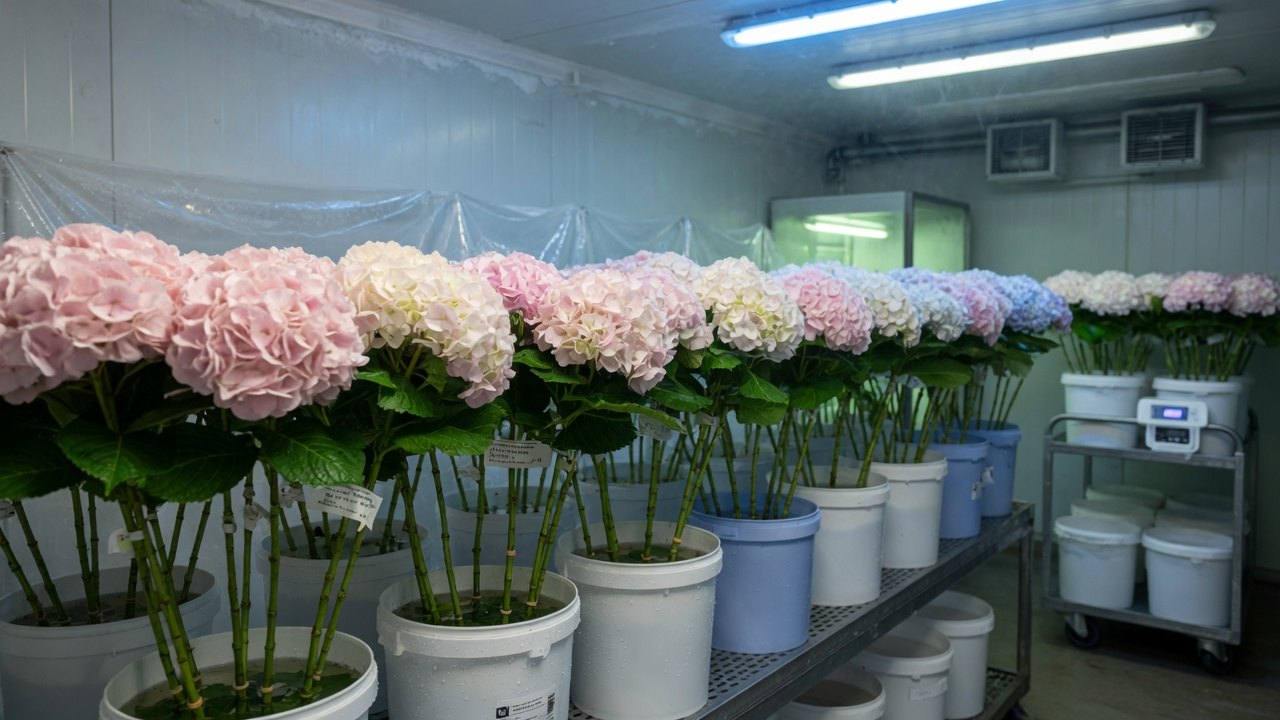
Rapid cooling is the single most effective way to lock in quality. Within 30 minutes of cutting, stems should be in a forced air pre-cooler at 2 to 4 degrees Celsius. Forced air pulls heat out of the core of the flower head, not just the air around it.
- Pre-cooling method. Do not rely on a standard cold room. Use a dedicated pre-cooling tunnel or room with high air velocity.
- Water quality. Use clean, cold water with a low pH (3.5 to 4.0) and a commercial hydrangea preservative. Change the water every two days.
- Ethylene alert. Hydrangeas are ethylene sensitive. Never store them with apples, pears, or any ripening fruit. Even low levels of ethylene cause premature petal drop.
“We started spending less and earning more after we fixed our post-harvest protocol. It was the easiest ROI we ever made.” ; Abdulla Khadziev, general manager, Kantyshevsky greenhouse complex.
Storage and the cold chain: the last mile
A perfect cold chain from farm to florist is rare. But you can control your own link. Storage conditions directly affect how long the flower stays saleable and how it performs in the customer’s vase.
- Temperature and humidity. Hold at 2 to 4 degrees Celsius with 90 to 95 percent relative humidity. Lower humidity dries the petals. Higher humidity promotes botrytis.
- Air circulation. Stagnant air creates hot spots. Ensure gentle, even airflow around every bucket. Stack buckets loosely, never block air flow.
- Darkness. Hydrangeas stored under continuous light lose color faster. Store in complete darkness. Only expose to light during grading and packing.
System beats chaos every time
Post-harvest discipline is not about expensive equipment. It is about a repeatable protocol. Write down your cutting stage criteria. Post a cooling checklist. Train every worker. Audit the cold chain monthly.
The difference between a grower who struggles and a grower who thrives is often not the size of the greenhouse. It is the care taken in the last 48 hours before the flower leaves the farm. If you want to build a system that earns predictable profit, start with the stem in your hand. Take our free diagnostic quiz System or Chaos? and see where your operation stands.
Put this into practice
The flagship program turns thinking like this into a season-by-season system.
Explore the program