Starting material economics: what berry growers underestimate
The cheapest strawberry plant often costs more than you think when you count mortality, uneven establishment, and lost cycles.
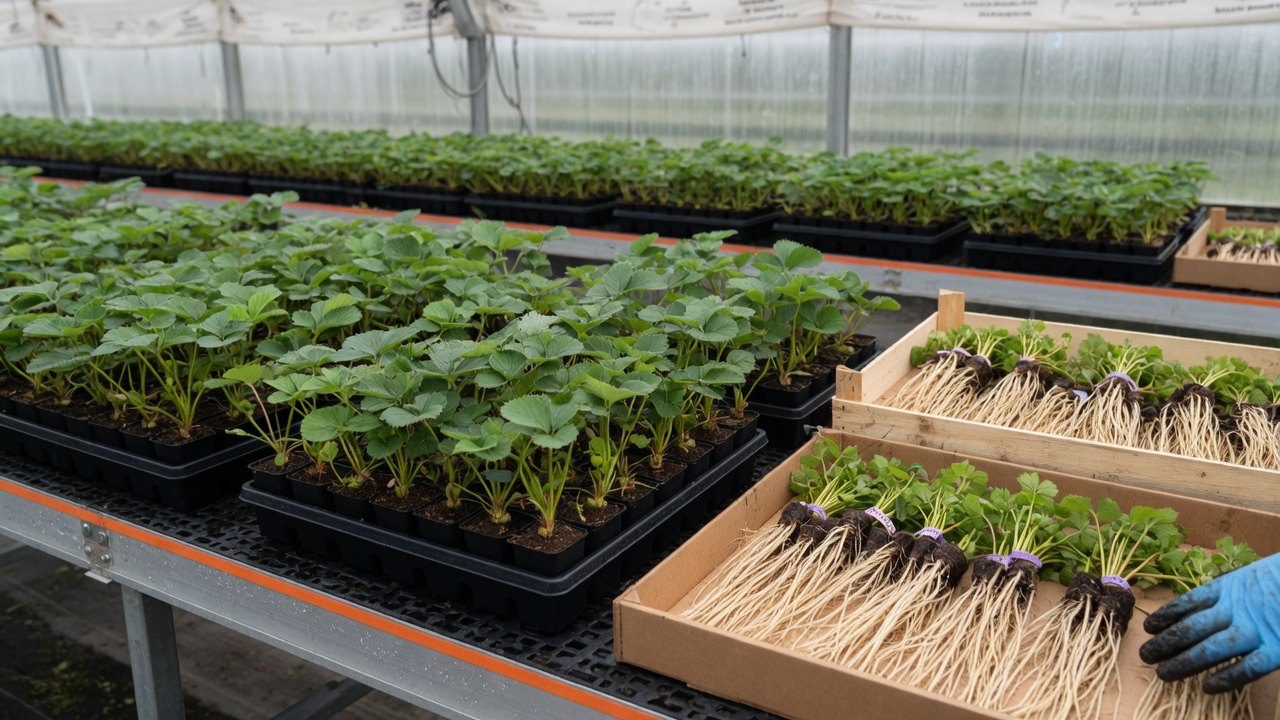
Every berry grower knows the pressure to cut costs. But the cheapest planting material is rarely the cheapest decision once you count mortality, uneven establishment, and lost cycles. In commercial strawberry production, the starting material determines not just your first harvest but the entire season's margin. At Agro Academy, we see too many growers optimize the wrong variable: price per tray instead of cost per harvested kilogram.
Why cheap plants hurt your bottom line
Low-cost strawberry plants often come from nurseries that skip virus testing, use inferior mother stock, or rush the hardening process. The result is a cascade of hidden costs.
- Higher mortality rates. A 5% die-off might seem acceptable, but replanting costs labor, delays your schedule, and creates gaps that reduce overall yield. In a 10,000-plant tunnel, that’s 500 lost plants and up to 2% lost revenue from uneven maturity.
- Uneven establishment. Weak plants grow slower, flower later, and produce smaller berries. This forces you to pick selectively, wasting picker time and leaving value in the field. In our trials, quality plants from Henselmans Strawberry Plants establish 3-5 days faster and show 90%+ uniformity.
- Lost cycles. With poor material, you might delay your first flush by a week or more. In a short season, that means missing the premium price window. The opportunity cost often exceeds the initial saving on plants by a factor of ten.
The unit economics of quality
Let’s run the numbers. A high-quality tray of 100 strawberry plants from a reputable supplier like Henselmans costs €15-€18. A budget tray may be €10-€12. But the budget tray often has 8-12% mortality versus 2-3% for quality plants. If you plant 50,000 plants, that’s 4,000-6,000 dead plants versus 1,000-1,500. At €0.15 per plant, you save €600-€900 on initial purchase, but you lose €1,200-€1,800 in replanting costs and lost yield. The math flips.
“The cheapest plant is the most expensive mistake you can make. I’ve seen growers lose 20% of their potential revenue by saving €200 on a batch of trays.” ; Anna Kruzo, founder Agro Academy
Add in the cost of uneven fruit size and delayed harvest, and the quality plant pays for itself before the first pick. That’s why we partner exclusively with Henselmans Strawberry Plants, a family business with 60+ years of experience producing virus-free, well-rooted runners. Their material is the foundation of our Berry Business program, now in development for 2026.
Building a system that starts right
At Agro Academy, we believe that profitable berry growing is a system, not a gamble. That system begins with the right genetics and nursery practices. Our upcoming Berry Business program will cover everything from variety selection and planting schedules to fertigation and postharvest handling. You’ll learn how to evaluate suppliers, run simple on-farm trials, and calculate your true plant cost. The program includes a 2026 study tour to the Netherlands, where you’ll visit Henselmans and see their propagation firsthand.
Don’t let a false economy of cheap plants define your season. Start with material that gives you a fighting chance. To learn more, explore our programs or contact us at Agro Academy.
Put this into practice
The flagship program turns thinking like this into a season-by-season system.
Explore the program